


by Steve Bechtel
I own a gym and we’re dependent on members to stay afloat. Why in the world would I write an article about building out a home gym? Because I see a need for making sure that every athlete has the greatest number of opportunities for progress, and different environments provide different opportunities. What we are going to talk about today is schedule, environment, and training needs.
Let me give you an example. CS Coach Joel Unema lives just three blocks from my gym, but trains almost exclusively in his home gym instead of taking the five minute walk to our place. Why? Because Joel has a tight schedule some days, likes to train for hours, and has some really specific goals that can’t be addressed in a commercial setting as they can be at home.
Strangely enough, Ellen and I have a home gym, too. Same thought process: some of my sessions are selfish with space, require extensive circuits, and sometimes take a long time. If I am breaking for 20 or more minutes between long circuits, it’s nice to be able to do something around the house…or just sit there quietly.
Whatever your need for a home gym, space, privacy, or lack of any gym nearby, it’s important to consider the utility and cost of your tools. A huge, adjustable angle spraywall might be attractive, but is it worth the space and the money? Below, I’ll go through some essentials of a training space, and then talk about ways to make your money go further.
Climbing Space
The first stop in building a home gym is considering whether you have the space for a climbing wall. It might be that you have room for a 12’ x 16’ board, but most of us are lucky to be able to fit a Moon Board Mini in the garage. Remembering that this is a skill sport and that we all like to climb, figuring out even a small space is a good first step. I’ve seen boards as small as 8’ x 6’ that were fun to use, so don’t assume a small pace is useless. Remembering that steepness can bring you more climbing length and intensity is helpful, too. Even if you do most of your climbing on vertical terrain, a 45 degree board might be your best option.
Commercial spray walls are all the rage, and the lights and established problems are great. The minimum entry for most of these boards is close to $10k, though. By far my favorite walls in this category are not mass produced. Some of the best I’ve ever climbed on were built from wood scraps and retired gym holds.
The entry here is framing, high quality plywood, and maybe tee nuts. Instead of spending ten grand, you will get the same high-quality training for less than $2k. Climbers can often source used plywood panels for low cost, and buying used holds from commercial gyms is common.
It’s also worth considering whether you need a fixed-plane board like the ones described above, or if a more varied terrain space is a good idea. The best part about building and experimenting is that you can change your mind. Back in the 1990s, my friends and I built a climbing gym in my garage to get us through the long Laramie, Wyoming winters. Over the course of a couple of seasons, we built / tore down / and rebuilt various walls before feeling like we got the angles and space right. We were able to reuse most of the lumber each time, and the only cost was a little labor and creativity.
If you have the room for it, some kind of climbing space should be central to your home gym. I caution against a “hard-problems-only” board, as I think that climbing volume is also something that should be addressed. If you can’t build a full board, then a limited-movement area is the next thing I’d recommend.
Limited Movement Area
A “limited movement area” is simply a small board that allows doing only one or two movements at a time, such as a systems wall or a short campus board. One of the simplest ideas here is to stack a couple of hangboards so that you can do offset work or short movements. Todd Skinner had a small “Rhythm Board” in his basement that consisted of a single 4x8 sheet of plywood and just a few matched pairs of holds. He used it as a warm up area, but also as a place to train specific movement. He felt that simply hanging on pockets was not the best way to get his fingers ready for hard limestone climbing. Instead, he worked to put the small pockets further and further apart on the board and work to own that movement.
This type of board is especially useful in an apartment or bedroom. Often, sucha board creates much more memorable and substantial gains than a more robust climbing space might. There are just way too many stories of crushers that come out of “the cellar” forever changed by trying the same limite number of hard moves.
One of the early famed European boulderers trained primarily on a two-rung campus setup above his apartment door. The top rung was larger, maybe 15mm, and allowed for extended hangs and pull-ups. The bottom rung was small, maybe 6mm, and he could only work his way up to using it after a lot of work on the top rung. When he could work into moving down-up-down-up and matching the bottom, he knew he was close to peak strength.
A simple way of framing the idea of this kind of tool is to look at what kind of space you truly have, then build a board around it. Instead of “famine” thinking, “I don’t have space for a Kilter Board, therefore I can’t climb at home,” you need to switch to a mindset of possibility: “Three feet by three feet is going to be something I can work with!”
The Minimalist’s Training Zone
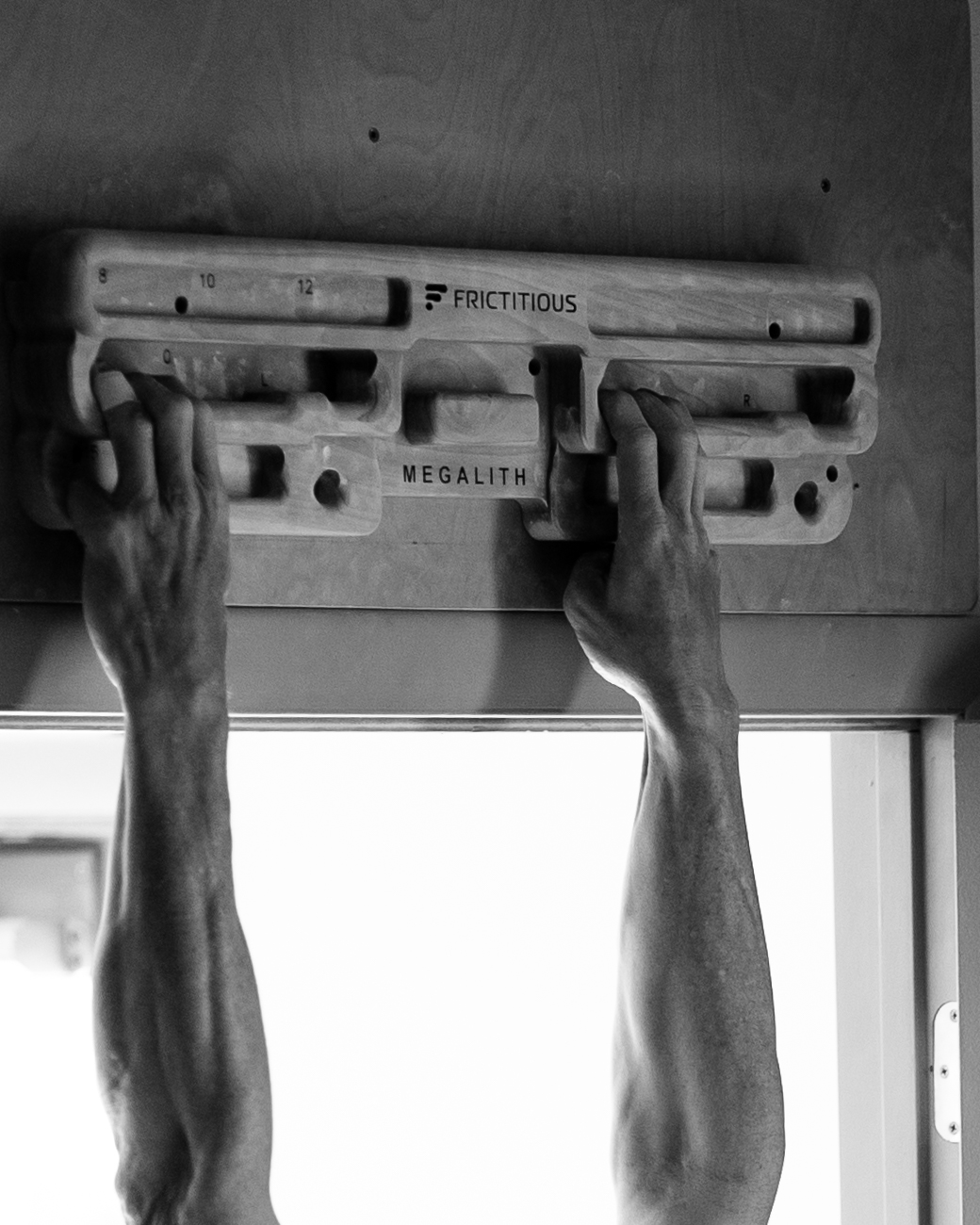
When you really have no space and almost no budget for things, you should think in terms of a small set of tools that can be stored easily. If at all possible, this training zone should be built around a hangboard. You can even buy a nice hanging bracket, so you don’t have to drill into your apartment’s door headers.
My checklist for a minimalist’s training zone is this:
- Hangboard.
- Two kettlebells or dumbbells, one “light” and one “heavy.”
- An elastic strength band - NOT a theraband.
- A stool or bench.
You might be inclined to think that the hangboard is all you need. Over the years I have found that people that have just this tool tend not to make the most of a workout. Your inclination to do even more hangboarding starts to diverge from wise training…instead, consider adding the ability to diversify your training slightly.
By adding the ability to do a little strength training alongside the hangs, you will increase your interest in the training, and will cover a lot more bases.
The elastic band will let you add load or reduce load (depending on whether you are resisting it, or using it to assist in the movement), and the two different weights will give you multiple options for exercises.
Finally, the stool gives us an implement for strength exercises such as step-ups or rows, as well as a simple way to unload some hangs.
If You Give A Climber A Hangboard…
By far the most exciting part of having a home gym is actually using it. You put up your hangboard and start training. Then you buy a dumbbell and add in some leg and arm work. Then a band…
And what goes into the home gym next?
Consider…
- A simple exercise mat. It’s amazing how much more likely I am to do floor-based work with a mat than on a hardwood floor.
- A foam roller. I don’t think these are miracle tools, but having one around coaxes me to use it, and do some supplemental stretches, way more than if I just have a bare floor.
- A suspension trainer. These are relatively inexpensive, and having a set of these, or a set of rings, opens up a whole host of general exercise options. Plus they are light, compact, and easy to store in a closet.
- A matched dumbbell or kettlebell for your existing light and heavy ones. Having two equal weights starts to be really useful. Obviously, you can double the load of your training, yet having a second weight allows you to do much more variety of exercise exercises.
- A superheavy weight. The third tool in your weight set up should be a kettlebell or dumbbell that scares you a little bit. In the kettlebell world, the 106 pound “beast” fits this bill. For most climbers, a weight like this could be used for heavy rows, deadlifts, swings, and more.
- A weight bench. This might seem silly, since you probably already have stools and chairs, but a dedicated weight bench is really useful if you start training more general strength at home.
- A barbell set. I am all about dumbbells for the home gym, but once you get strong, there is not a better tool than a barbell. We’re talking lifetime fitness and overall athleticism here, and we are a ways from specifically aiming at climbing.
Again, the goal of the home gym is to help a climber be more consistent in training, and to address essential elements. The constraint of having just one kettlebell, or nothing more than a doorjamb edge can be educational and, at times, essential to progress. It’s just one more way to say “yes” to progression, even on the days you don’t quite feel like doing anything.